Léa is scrolling on her couch on a Tuesday night that already feels like Thursday. She has a towel wrapped around her wet hair.
Her feed is full of shiny scalps and hair flips in slow motion, all promising “scalp spa at home” miracles that will give you Disney-princess volume in 30 days.
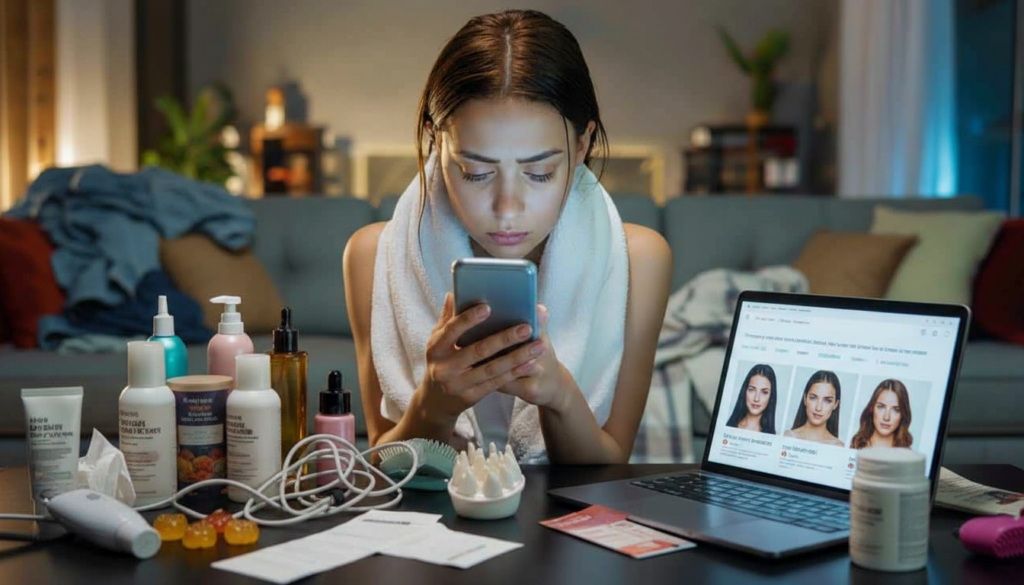
She sees a creator pour peppermint oil on her parting, drag a gold-plated massager across her head, and whisper about “activating follicles” like someone else might whisper about making money.
Without thinking, Léa adds a 49€ scalp brush to her cart.
She thinks about what her life will be like in six months for just a second.
New job, new confidence, and hair that falls over her shoulders.
The ad changes, and the next woman comes on, running her fingers through her hair like a promise.
This doesn’t seem right.
Very wrong.
When “self-care” starts to look like a trap for monthly subscriptions
The trend of having a scalp spa at home didn’t just happen.
It quietly made its way into our bathrooms through polished “Sunday reset” vlogs, TikTok, and Instagram Reels.
It seems safe at first.
A minty serum, a soothing brush, and a short massage routine.
A way to get some time back for yourself in a world where your boss still texts you at 9:42 p.m. the words change.
You’re not just taking care of your scalp anymore; you’re “healing trauma stored in your roots” and “reversing years of damage.”
Your shampoo doesn’t just clean your hair anymore.
It’s a part of the story about your self-worth.
Check out how the numbers match up.
Market researchers say that the global market for hair loss treatments is worth billions of dollars, and women are becoming more and more the target of vague terms like “density” and “volume health.”
A viral scalp spa routine on social media can get hundreds of thousands of views.
There is a shopping list under each video that includes an exfoliating scrub, pre-wash oil, detox shampoo, a micro-needling roller, a peptide serum, a silk towel, and hair growth gummies.
A 21-year-old student in Lyon told me she had spent almost half of her monthly rent on these products over the course of three months, trying to get baby hairs that never came.
She laughed when she said it, but then she stopped talking.
You could hear the mix of shame and hope in that pause.
At first glance, the logic behind the trend seems almost scientific.
Massaging the scalp can help blood flow.
Exfoliation can get rid of sebum and product buildup.
So the promise is based on a half-truth.
If circulation is good, more blood gets to the follicles. If the follicles are happy, hair will grow like crazy.
Brands stretch that thread as far as it will go, filling it with fake medical terms and perfectly filtered before and after photos.
Dermatologists always say the same thing: a clean, balanced scalp is good for hair.
You can’t turn genetics, hormones, or long-term stress into a scented scrub problem.
The industry is very aware of this.
But desperation buys more than what is real.
The thin line between caring for your scalp and being obsessed with it
There is a way to take care of your scalp that is really nice.
Think of it as taking care of your hair like you do your teeth: simple, regular, and boringly consistent.
You might wash your hair when your scalp feels greasy, not when an influencer tells you to.
Picking a shampoo that doesn’t make your skin sting, itch, or make you scratch.
While you’re already in the shower, spend two or three minutes massaging with the pads of your fingers instead of your nails.
A gentle exfoliating lotion once a week can help if your scalp tends to flake.
Not a rough scrub that feels like sandpaper, and not seven different “detox” products stacked on top of each other.*Your scalp is skin, not a floor that needs to be scrubbed.
Most of the women I’ve talked to about hair loss don’t fall for marketing tricks.
They’re just worn out.
Sick of seeing more hair in the drain.
They are tired of seeing their part get bigger in pictures.
So they put things on top of each other like armor.
When the roots look greasy and the skin starts to itch, people panic and put oils on serums and tonics.
Some people rub so hard with “stimulating brushes” that they hurt their scalp, which can make shedding look worse.
Next comes the guilt.
Maybe they’re not doing enough if the hair isn’t growing.
Not consistent enough, not disciplined enough, and not “high-maintenance” in the way that beauty culture now celebrates.

The truth is that most home scalp spa routines make big promises about hair growth.
It feels good to get a massage.
It can help relax the muscles and make you feel like you have some control for a short time.
But the most important things for hair health are still boring: eating a balanced diet, getting your iron and vitamin levels checked by a doctor, managing stress, and getting treatment for real problems like thyroid problems or androgenetic alopecia.
No viral rosemary oil will fix a hormone imbalance.
One dermatologist I talked to was very clear:
“The trend worries me because it moves the responsibility from medicine to cosmetics.
Instead of asking for a proper diagnosis, women blame themselves for not buying the right serum.
Reframing the whole thing helps.
Instead of saying, “What else can I buy?”Try saying, “What can I make easier?”
- Use a simple, mild shampoo that doesn’t bother you.
- Don’t add five treatments at once; add one at a time. You should keep an eye on how your scalp reacts for a few weeks.
- If a professional hasn’t told you to, don’t scrub or micro-needling too much.
- Once a month, not every day, take pictures of your hair in the same light to see how it changes.
- If your hair is falling out suddenly or a lot, the first thing you should do is get a medical check-up.
Taking your head back from the business of feeling insecure
The scalp spa craze touches something deep down, even though the packaging is shiny.
Hair is who you are.
For a lot of women, it’s a mix of femininity, sexiness, and even professional credibility.
Losing it, or even being afraid of losing it, feels like failing at a job you never wanted to do.
This is what algorithms know.
They keep track of how long you pause on a video about “thin hair hacks” and then give you twice as many overnight growth miracles.
Each one tells you that your body is a problem that you can fix with a cart full of stuff.
We’ve all been there: that time when you look in the mirror after a shower and count the hairs on your brush like they’re a verdict.
That’s exactly where marketing fits in.
Right into that little, worn-out crack in your self-esteem.
There is another path that doesn’t look as good in pictures, so you don’t see it trend very often.
It looks like a woman going to a dermatologist’s office with a list of notes instead of a beauty store with a list of discount codes.
It seems like deciding that “good enough” hair is… enough.
It’s normal to lose some hair after having a baby, going through a lot of stress, or getting older. It’s not a scandal that needs to be erased.
Make an appointment for a scalp check, and then use the rest of your money on things that make you happy instead of constantly checking yourself.
Let’s be honest: no one really does this every day, no matter what the “daily routine” videos say.
Most people choose things that fit into their real lives, like work, kids, laundry, and the need to just lie on the couch and do nothing for a while.
The picture gets clearer when you pull back a little.
A multi-billion-dollar business that sells solutions to a problem it quietly makes worse with every anxious video.
You can’t get out by not caring or giving up your bathroom habits altogether.
It’s to change the terms of the deal.
Every time a miraculous bottle shows up on your screen, ask yourself, “Is this about my scalp or my fear?”
Some readers will keep their Sunday night scalp massages because they like the peace and quiet.
Some people will throw away three-quarters of their things and feel better right away.
When your own priorities, not someone else’s sales goal, guide your choice, both are valid.
Like all beauty waves, this one will pass.
Your relationship with your body and your bank account will last longer than it will.
| Key point | Detail | Value for the reader |
|---|---|---|
| Scalp spas don’t override biology | At-home rituals can’t reverse genetic or hormonal hair loss, only support overall scalp comfort | Reduces false hope and encourages medical advice when needed |
| Simpler routines work better | Gentle cleansing, light massage and one or two targeted products are often enough | Prevents irritation, saves money, makes care sustainable long term |
| Marketing feeds on insecurity | Social platforms push growth promises to women worried about thinning, nudging overconsumption | Helps readers spot manipulation and protect their emotional and financial wellbeing |
Questions and Answers:
Question 1: Does a home scalp spa really make hair grow faster?
Question 2: How often should I safely massage or scrub my scalp?
Question 3: Are micro-needling tools and scalp brushes safe?
Question 4: When should I go to the doctor instead of buying more stuff?
Question 5: What is a simple, doable scalp routine that works?