
One hand is holding a venti iced latte and the other is scrolling through TikTok on her phone. Under the neon lights, her foils shine like armor. It’s her “refresh” appointment, which is the third time in eight weeks. The stylist says, “You’re addicted to this chair,” and they both laugh, half-joking and half-serious.
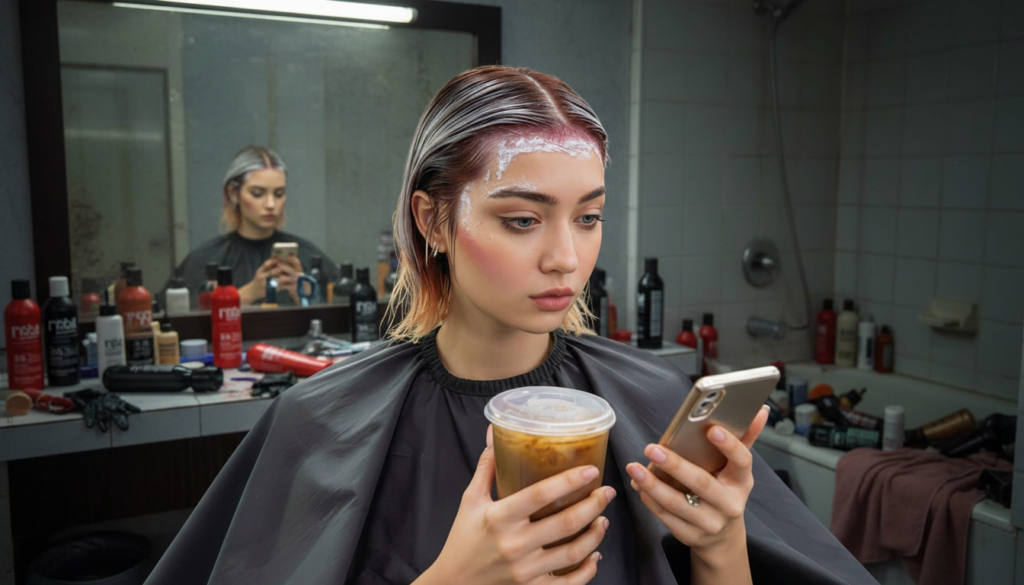
Another client behind them winces as the color touches her already sore scalp. She says that pain means it’s “working better.” The air smells like ammonia, coffee, and a little bit of denial.
No one in the room is really asking the question that hangs between the ring lights and mirrors.

How often is too much?
When “just a touch-up” never really ends
On a Saturday, if you walk into a busy salon, you’ll feel the quiet rush of people waiting to get a slightly different version of themselves. Roots, glosses, toners, full color, and highlights on top of highlights. The reminders on my calendar keep piling up: every three weeks, every month, and sometimes even every ten days.
It’s called “maintenance” by stylists. People call it “self-care.” A lot of scalps are waving tiny red flags that no one wants to see between those two words.
One colorist in London told me that some of her clients make standing appointments every three weeks to have their roots touched up with permanent dye. Not just a gentle toner, but full oxidative color on the same part of the scalp and hair, again and again.
“Some of them started coming every few months,” she said. “Then we pushed it closer and closer.” They get scared if they see four millimeters of gray now. She has seen patches that are flaking, burning, and even oozing covered up with calming serums and a nervous laugh. Most of those clients, though, still don’t want to extend their appointments.
There isn’t a medical term for “hair dye addiction,” but the behavior is easy to spot. It works just like any other cycle of anxiety and reward. You see roots, feel exposed, rush to cover up, feel better, and then start looking for the next flaw.
The chemicals don’t care what you’re telling yourself in the mirror. Permanent dyes use ammonia or other chemicals that make the hair cuticle more open, as well as oxidizing agents like hydrogen peroxide. If you use that mix too often, it can irritate the scalp barrier, cause dermatitis, and slowly weaken the follicles that are supposed to protect you for life. The routine that makes you feel in control can slowly wear you down.
So, how often is “too often” for hair dye really?
Dermatologists I spoke to came up with similar numbers: for permanent dye on the roots, every 4 to 6 weeks is the usual safe-ish time for a healthy scalp. That’s about how long it takes for your hair to grow enough so that you can only focus on the new growth instead of the same skin and strands.
Quick toners and glosses are lighter, semi-permanent colors that usually sit on top of the cuticle instead of inside it. This makes them less harsh. You can usually do those every 6 to 8 weeks, and sometimes even sooner if your hair is strong and your scalp is calm. The problems start when permanent and semi-permanent sessions turn into one long, chemical haze.
We’ve all had that moment when you look in the mirror at work and all you can see are those stubborn greys along the parting. For some people, that flash of pain makes them go straight to an express root cover-up two weeks after getting their hair dyed. Then maybe a gloss before the big day. Then I had to fix the color because the tone changed a little.
A dermatologist in New York told me about a client who colored their hair every two weeks for almost a year. At first, she ignored the mild itching. Then it hurt. Then there were angry red patches on the scalp and along the hairline. When she was done, there were small patches where her hair just wouldn’t grow back right. No one in her beauty circle had ever said “pause” out loud.
Let’s be honest: no one really reads the box of dye and says, “I’ll strictly space this out and patch-test every time.” We think of hair dye as makeup, not as a chemical process that changes living tissue.
Many trichologists say the same thing over and over: putting permanent color on the same part of your scalp more than once every four weeks is risky, especially if you’re also getting other services like bleaching, straightening, or tight extensions. Another topic that doesn’t get enough attention is sensitization. You could use a product for years and then suddenly become allergic to something in it, like PPD (para-phenylenediamine). Overuse isn’t the only thing that can set it off, but it does push your immune system a little closer to the edge each time.
Paying attention to your scalp before it screams
A good rule that hairstylists who really care about the health of your hair follow without saying anything is to match your routine to your scalp, not your schedule. Do a 30-second check before you book that extra touch-up. Run your clean fingers over your scalp, especially along the hairline, behind your ears, and at the back of your head.
Is the flaking more like dry, thin tissue than just dandruff? Are there little scabs from scratching? Does your scalp hurt when you wash your hair? Your scalp is telling you that the barrier is broken. If that’s the case, the best “beauty hack” is very simple: reschedule your next appointment. For a month or two, stop using harsh permanent dyes and switch to semi-permanent dyes or root sprays instead.
Stylists say that some of the most common mistakes happen when people are not in the salon. People put boxed dye on hair that has already been dyed. Instead of focusing on the roots, they pull color all the way through every time “just to refresh.” They change brands all the time in search of the perfect color, which doesn’t give their scalp time to adjust or heal.
The trap is emotional in the professional world. A colorist wants you to be happy when you leave. You want the change to happen quickly. If you say “no, your scalp needs a break,” you might feel like you’re letting someone down or losing a client. That’s why stylists on TikTok are now posting raw videos of chemical burns and breakage: it’s a quiet protest against the pressure to say yes to everything. It’s not about being scared. It’s about giving your consent with real information.

During our interview, one experienced colorist said it like it was.
“Beauty is pain” is not beauty anymore if your head is on fire and you still say, “Just push through.” That’s hurting yourself with foils.
- If you want to stop coloring all the time, setting some limits can help:
- Space out permanent root dye sessions by at least 4 to 6 weeks.
- When you can, use semi-permanent glosses instead of full dye.
- Instead of extra chemical sessions, switch to root powders or sprays between visits.
- Don’t put permanent dye on your whole head again just to make it shine.
- If you notice that your scalp is always red or burning, make an appointment with a dermatologist or trichologist for a “scalp check.”
The thin line between care and force
Having different hair colors can be fun. It can be brave, rebellious, expressive, or even healing. It’s real that rush you get when the cape comes off and you feel sharper and more like yourself. The issue arises when that sensation becomes the sole means of identifying your reflection. When one visible root suddenly means “I look old,” “I look tired,” or “I look like me, and that’s not enough.”
*At that point, the bottling isn’t just happening in the color tube. It’s also happening in your head.
There is a quieter story that doesn’t get told very often: the woman who went from getting her hair dyed black every three weeks to a soft mix of her natural gray with subtle highlights every three months. Or the guy who stopped dyeing his hair with box dye and let the salt-and-pepper grow in. He found that a good cut and scalp massage made him feel better than any jet-black shade ever did.
People who see their work as long-term care, not just short-term change, are starting to use the term “scalp longevity.” The idea isn’t against dye. It helps your future self. You might want those follicles to be working, not scarred and tired, in ten, twenty, or thirty years.
When your phone reminds you of an appointment, take a second before you tap “confirm.” You should ask yourself this simple question: Am I making this appointment because my hair and scalp are ready, or because I’m not?
There isn’t a single magic number that means “too often.” This line is always moving between what your hair can handle and what your self-image wants today. The key is to learn how to tell the difference and then have the guts to make that gap bigger, even if it’s only a week or two, so that your reflection doesn’t feel like a crisis every time the roots come back.
| Key point | Detail | Value for the reader |
|---|---|---|
| Safe-ish frequency for permanent dye | Every 4–6 weeks on roots, avoiding repeated overlap on the same scalp area | Gives a concrete benchmark to plan color appointments without overloading the skin |
| Warning signs from your scalp | Burning, redness, flaking, scabs, or itching that worsens after coloring | Helps you spot early damage before it turns into long-term irritation or hair loss |
| Gentler in-between strategies | Semi-permanent glosses, root sprays, powders, and embracing some natural regrowth | Offers realistic ways to stay confident between appointments while protecting scalp health |
Questions and Answers:
How often can I safely use permanent color to dye my hair?
Most dermatologists say to wait at least 4–6 weeks between permanent root touch-ups. Instead of pulling dye through your whole length, focus on new growth.
Is it safer for my scalp to use semi-permanent dye?
Semi-permanent formulas are generally gentler because they coat the hair instead of penetrating deeply, yet frequent use can still irritate sensitive scalps, so spacing and patch-testing still matter.
What are early signs that I’m coloring too often?
Persistent itching, burning during processing, redness around your hairline, unusual shedding, or flaky, sore patches are all signals that your scalp barrier is struggling.
Can hair dye cause permanent hair loss?
Severe allergic reactions or repeated chemical irritation can, in some cases, damage follicles and cause hair to thin or fall out in patches that last a long time. This is especially true if you keep coloring your hair even when it hurts.
How can I make my hair last longer between salon visits without hating my roots?
Use tinted dry shampoo, root powders, or sprays. Change your parting. Try softer shades that are easier to grow out. Talk to your stylist about how to blend colors instead of making hard lines.