
The memory usually comes as a small thing.
You’re halfway through making coffee, and the radio is playing in the background. Then, out of nowhere, you can see the exact pattern of your grandma’s kitchen curtains from 1983. Yellow lemons, a faded stain near the sink, and the chipped blue mug she always used for ‘your special hot chocolate’. You didn’t try to remember it. It just came, fully formed, like a scene waiting to play on your mind’s own streaming service.
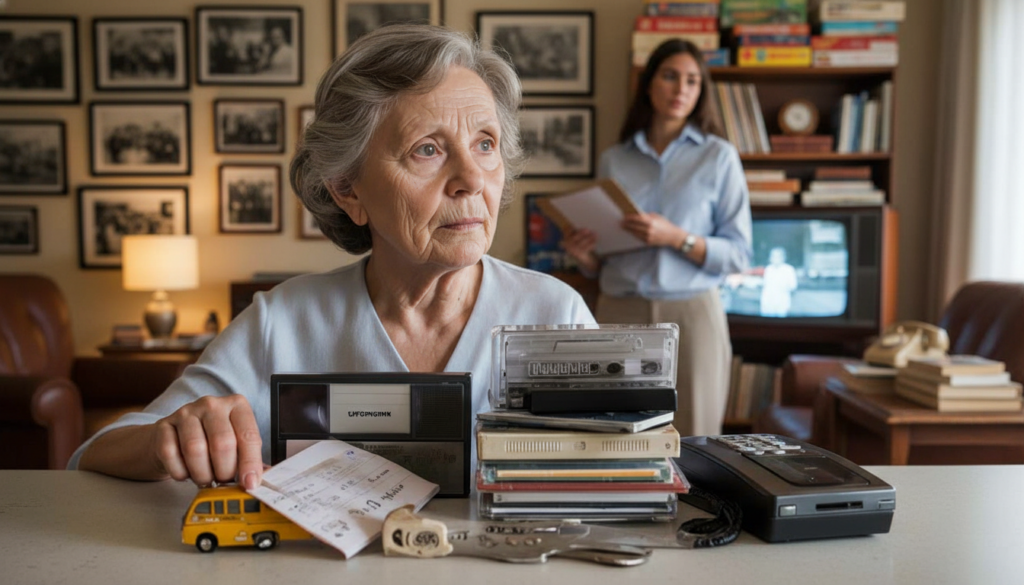
Your doctor recently talked about “age-related decline” while tilting their head in a sympathetic way.
But your brain is quietly replaying clear memories from 30, 40, and 50 years ago.
There is something in that space that doesn’t make sense.

When your brain goes back in time and the tests don’t see it
Most of the memory tests you get at the doctor’s office feel like a surprise quiz. Say three words again. Draw a clock. Count down from seven. It’s all very polite and organised, but it’s strange how memory works in real life.
Meanwhile, your brain is busy doing its own thing.
You hear the first two seconds of the old Nokia ringtone and you are instantly taken back to 1999, when you were holding that big, heavy phone and hoping the prepaid credit would last until Friday.
That isn’t on any of the questions.
For example, take a woman named Margaret, who is 72.
Her son noticed she was forgetting where she left her keys, so the family pushed for an assessment. In the clinic, under fluorescent lights, she froze on the “repeat these words” task. She got the date wrong. She walked out with a label on her head that sounded like a life sentence.
But at home, she could talk for twenty minutes about how the vinyl seats on the bus she took to school in the 1950s smelt.
She remembered the name of the driver, the slogan on the side of the bus, even the jingle from the detergent ad that played at the cinema that year. That rich, layered recall never showed up on her chart.
We don’t talk about this gap enough.
Dementia is real, devastating, and tragically underdiagnosed in many places, yet a quieter issue is emerging: subtle overdiagnosis or mislabeling of people whose brains are changing, but not in the way those quick screening tests assume.
Memory isn’t one big muscle that either “works” or “doesn’t.”
It’s a patchwork of systems: short-term, long-term, autobiographical, emotional. One can wobble while another stays razor sharp. When your 40-year-old memories are vivid enough to taste and touch, that often tells a very different story from the one a ten-minute waiting room test suggests.
10 strangely specific memories that tell a hidden story
Let’s get concrete.
If you can recall any of the following types of moments from decades ago, with clear sensory detail, your long-term autobiographical memory may be doing far better than you’ve been led to believe. This isn’t a diagnosis, just a different lens.
1. The feel of rewinding a VHS tape and the exact sound it made.
2. The smell of fresh ink on paper school report cards.
3. The day your town replaced the old rotary payphone with a “modern” push-button one.
4. The color of the carpet at your first job, and how your shoes sounded on it.
5. The taste of a discontinued snack and the store you bought it from.
6. The jolt in your chest watching the moon landing or Live Aid or the Berlin Wall.
7. The way your mum or dad said your name when you were in serious trouble.
8. The first time you heard your favorite song on a cassette or vinyl, and where you were sitting.
9. The brand of your first car and a specific drive you took in it.
10. The exact layout of a childhood room you haven’t seen in 40 years.
I spoke with a retired bus mechanic in his late 70s whose daughter was worried about his “slipping memory.”
He couldn’t remember her new Wi‑Fi password to save his life, which spiraled into a late-night Google search on dementia. At the clinic, the minute he miscounted a sequence, the atmosphere shifted. You could almost feel the “this confirms it” in the room.
Yet when he talked about the buses he serviced in the 1960s, he could trace every pipe, every bolt, every sound an engine made when something was off. He remembered the registration numbers, the weird smell of one particular oil brand they stopped using after 1972, the name of the apprentice who always forgot to tighten one specific screw.
Those are not the memories of a brain “shutting down.” Those are the memories of a brain that organizes information in a deeply personal, mechanical, and story-based way.
Plain truth: most memory tests are built to be quick, cheap, and standardized, not to capture the messy richness of a full life.
They’re good at flagging serious red alerts. They’re less good at understanding the quiet difference between “I’m slower at pulling up names” and “my sense of who I am is crumbling.”
So when you can recall a TV broadcast from 1976, the brand of biscuits at your aunt’s house, and the exact route you biked as a teenager, that suggests your autobiographical memory networks are still firing.
That doesn’t cancel out real worries or rule out early dementia, but it exposes a silent problem: we’re sometimes judging people’s entire cognitive future based on tasks that barely touch the memories that actually matter to them.
How to talk back to the narrative around your memory
One surprisingly effective step is to build a simple “memory map” before your next appointment.
Sit down with a notebook or a notes app and list 10–20 moments from at least three different decades of your life: childhood, early adulthood, midlife. For each, jot down what you remember in sensory detail—what you saw, heard, smelled, felt.
Do it casually, like storytelling, not like homework.
You’re not trying to prove anything, you’re just documenting how your brain naturally retrieves lived experience. *This is your counterweight to the narrow snapshot of a clinic test.*

When you see a doctor or specialist, bring that memory map.
If you feel rushed, you can calmly say, “I know I struggled with some of the short tests, but I want you to also see how my long-term memory works in everyday life.” Then you read out a couple of those razor-sharp memories, the way you’d tell a story to a friend.
A lot of people feel embarrassed to push back, as if questioning the process makes them “difficult.” We’ve all been there, that moment when you nod along even though something in your gut says, this doesn’t quite fit me.
Yet those stories are data. They show pattern, continuity, and depth a clock-drawing simply can’t.
“Doctors see you for twenty minutes,” one neurologist told me, “but your stories show me how your brain has been working for decades. I’d be worried if those old memories felt flat, colorless, or full of holes. Vivid detail usually means those networks are alive and well.”
Write your memory map
- Pick 3–4 key decades and capture specific scenes, including small details like sounds, clothes, or smells.
- A partner, friend, or adult child can describe what they see day-to-day: lost keys, yes, but also the way you remember old neighbors or songs.
- Instead of “Do I have dementia?”, try “Which parts of my memory seem affected, and which are strong?”
- Keep a short, honest log over a few months. Some forgetfulness is stress, sleep, or meds, not permanent decline.
- If a label doesn’t match your lived reality, you’re allowed to request a second opinion or more detailed testing.
There’s a strange loneliness in carrying decades of memories that nobody else shares anymore.
You mention the exact color of the plastic chairs at the old community hall and people half your age blink, polite but blank. Your mind is full of things the world has already thrown away.
That can feel like a burden. It can also be a clue that your brain is doing a lot more work than the phrase “age-related decline” gives it credit for. Those lemon-pattern curtains, the weight of a landline handset, the clunk of a cassette player stopping mid-song: they’re more than nostalgia.
They’re proof that your mind still knows how to weave detail, emotion, and context into a story only you can tell.
| Key point | Detail | Value for the reader |
|---|---|---|
| Long-term memory can stay strong even as other skills slow | Vivid recall of specific scenes from decades ago suggests active autobiographical networks | Helps you question a one-size-fits-all narrative about “fading” memory |
| Standard tests don’t capture real-life remembering | Quick screenings focus on short-term recall and abstract tasks | Encourages you to bring your own stories and examples into medical conversations |
| You can actively reshape the dialogue with doctors | Using a “memory map,” second opinions, and better questions | Gives you more control, reduces unnecessary fear, and supports more accurate diagnoses |
FAQ:
Question 1 Can strong old memories mean I definitely don’t have dementia?
No. Dementia is complex and can affect people in different ways. Strong long-term memories are reassuring, but they don’t rule anything out on their own.
Question 2 Why do I remember the 1970s better than last week?
Because long-term, emotionally charged memories are stored differently. Short-term and working memory often change first with age, stress, or illness.
Question 3 Should I worry if I keep losing my keys?
Not automatically. Losing objects, especially when distracted or tired, is extremely common. Patterns of personality change, confusion about familiar places, or safety issues are more concerning.
Question 4 What kind of doctor should I see for a deeper assessment?
A neurologist, geriatrician, or specialized memory clinic can offer more detailed testing than a basic screening at a general practice.
Question 5 Is it worth pushing for a second opinion?
Yes, if the label you were given doesn’t match how you function in everyday life. Let’s be honest: nobody really lives inside a ten-minute test.