Instead of making color appointments months in advance, more and more people with graying hair are using a cheap, easy change to their regular conditioner. They say it gently softens silver strands back to their original color.
A softer answer to the question about gray hair
When pigment cells in the hair follicles slow down or stop making melanin, the hair turns gray. Age is a factor, but genetics, smoking, chronic stress, and not getting enough nutrients can all make things happen faster. For years, people have used permanent dye, root touch-up kits, or plant-based color that can be hard to control.
Permanent and semi-permanent dyes work quickly and dramatically, but they often contain chemicals that can make hair rough and irritate sensitive scalps. Even options that don’t contain ammonia change the structure of the hair inside. Frequent coloring can make hair break or frizz because it is already thinner and drier.
Natural routes like henna or indigo sound good on paper, but their colors can be red, orange, or inky blue-black, and it’s hard to fix mistakes. Once that color sticks, it usually stays put. For people who just want to tone down a few silver streaks without changing their whole look, those options can seem like too much.
There is a third option forming: tinting gray hair with cocoa mixed with everyday conditioner. This is better than harsh dye jobs or doing nothing.
The cocoa conditioner trick is becoming more popular.
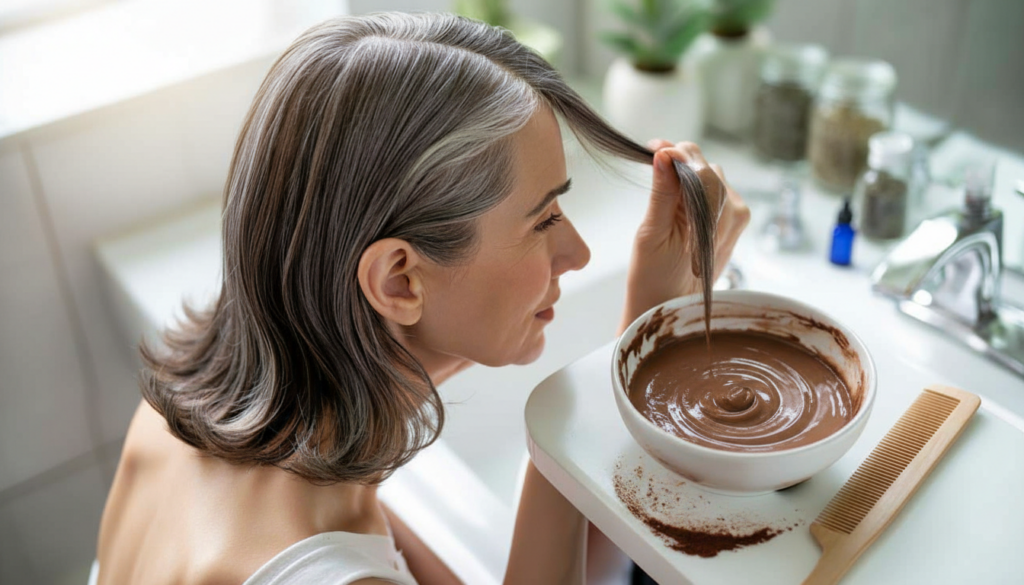
The newest social media craze doesn’t come from a lab; it comes from the baking aisle. When you mix unsweetened cocoa powder into a plain conditioner, it acts like a light, rinseable tint that slowly covers gray hair in a soft brown color.
Flavonoids and tannins are plant compounds that naturally stick to the outside of hair fibers. Instead of breaking open the cuticle, they sit on top and let light through. If you have light brown or blonde hair with gray streaks, that layer looks like a muted, smoky brunette color. It adds warmth and shine to darker bases without changing the color completely.
Cocoa brings more than just color, unlike most “coffee rinse” trends. It also has antioxidants that can help protect hair from damage from the environment, and it has a mild conditioning effect that can make coarse gray strands feel less wiry.
How to add cocoa to your conditioner
It’s easy enough to do on a Sunday night in the bathroom, and you don’t need any special skills.
- Wash your hair like you normally would, then gently dry it with a towel so it is damp but not dripping.
- Put some silicone-free conditioner in a clean bowl.
- Add 2 to 4 tablespoons of unsweetened cocoa powder, depending on how long and thick your hair is.
- Stir or whisk the mixture until it is smooth and all the same shade of chocolate.
- Divide the hair into sections and apply a lot of it, focusing on the gray areas at the roots, temples, and parting.
- Use a wide-tooth comb to spread the color evenly from the roots to the tips.
- You can leave it on for 20 minutes or up to 30 minutes if the white strands are very tough.
- Wash it with lukewarm water until the water runs clear, then style it as usual.
Results come slowly, not all at once. Many people say that after using it a few times, their stark white hairs turn into a cool beige or smoky brown color that blends in better with their base color.
Cocoa conditioner is like a tinted moisturizer for hair: it blurs, softens, and adds shine instead of completely covering or changing it.
Who sees the biggest difference?
This method won’t work for every grey head, and it’s important to have realistic expectations. The effect will be more or less visible depending on the color, texture, and amount of white in your hair.
| Hair profile | Likely cocoa outcome |
|---|---|
| Mostly grey, fine hair | Beige-brown cast, smoother feel, less stark contrast |
| Salt-and-pepper medium brown | Softer, more even shade, gentle blending of scattered greys |
| Dark brown or black with a few greys | Slight warmth and gloss; individual greys look less bright white |
People who have silver strands that are spread out across their heads, rather than a completely white head, are usually the happiest with the change. People with sensitive scalps also like that there aren’t any harsh chemicals. For people with very dark hair and a lot of gray hair, the change can be so small that it feels more like a gloss treatment than a real color change.

What cocoa really does to the hair shaft
Grey hair often feels different than it looks. The outer cuticle can sit higher, which makes strands feel rough and makes them stick together. Conditioner is already made to smooth the outside layer so that fibers can move more easily.
When cocoa is added, tiny bits of it stick to the surface of the smoothed hair. With each use, the soft tint gets stronger because it builds up layer after layer. These particles don’t get deep inside the hair or change the structure that makes it strong, unlike permanent dyes. That makes the method appealing for hair that is already dry and getting older.
Cocoa doesn’t bring back melanin from the inside; it just puts a soft, chocolate-colored veil over the hair.
How cocoa stacks up against other ways to fix gray hair
Many tips for the kitchen and the salon say they can “reverse” gray hair. Rinsing with coffee or black tea can leave hair feeling dry or rough, but it can also stain it. Salons that do professional grey blending can give you polished results, but it costs more and you have to go back for more. Tinted conditioners that you can buy at the store are somewhere in the middle. They add color while conditioning, but they may still have synthetic dyes or fragrance allergens in them.
Cocoa is unique because it is cheap, easy to find, and safe to eat. It can easily fit into an existing wash routine. The downside is that the results are different, and any build-up needs to be rinsed off well. The same powder that colors hair can also dull the surface or leave residue on the scalp if it is not washed out properly.
Checks for safety and setting realistic goals
Cocoa powder is safe to eat, but that doesn’t mean it won’t cause any reactions when used on the skin. People whose scalps are very sensitive, who are allergic to chocolate, or who have eczema patches around their hairline should be careful. A good first step is to put a small test patch behind the ear with a diluted mix.
Another thing that people often forget is that cocoa won’t make blondes a lot darker in one go, and it won’t make silver hair jet black. It looks more like a soft-focus filter than a full recolor. People who want to cover up strong white roots right away will still need to use regular dyes or hire a professional.
Looking past the bowl of conditioner
Genetics play a big role in how quickly hair turns gray, but lifestyle choices can also speed up the process. Some studies have found that chronic stress, heavy smoking, too much sun exposure, and diets low in antioxidants are all linked to faster or earlier pigment loss. There is no food or supplement that can guarantee a reversal, but living a generally balanced life can help the pigment cells that are still there.
People who start cocoa conditioning often say they also do other things at the same time, like using UV sprays on their hair when it’s very sunny, turning down the heat on their styling tools, and switching to richer masks with oils and lipids that protect brittle strands. Those changes can make grey hair look shinier and feel softer, even if the cocoa color isn’t very strong.
When this trick works best in real life
The cocoa method works best in certain situations. For example, someone who is growing out old permanent dye can use it to make the line between colored lengths and natural roots less harsh. A person in their 30s or 40s with a few early silver streaks might use it once a week to blur them without having to go to the salon.
There are also uses that are only good for certain times of the year. When it’s cold outside and your hair is already dry from heating it inside, switching one regular conditioner session for one with cocoa can add some depth without drying out the cuticle even more. Cocoa can help people who are thinking about fully embracing their natural gray hair by making the transition easier and less stressful. It’s a temporary, low-pressure way to get used to seeing more of their natural color in the mirror.